
Introduction
Major technological revolutions have always forced a renegotiation of society’s economic contract. The steam engine didn’t just mechanize cotton mills; it also restructured who owned wealth, who worked, and who the state served. AI is not different in kind, only in speed and scope. What is different is that, for the first time, the technology reshaping labor is itself intangible. That intangibility makes the policy question both urgent and difficult. The question is not whether to tax the wealth AI creates, but what, exactly, to tax, and through what legal outlets.
A key distinction is that labor impacted by AI is not the same as labor displaced by AI. Impacted workers still earn wages and pay taxes, often with AI augmenting their productivity. Displaced workers lose wages entirely, removing income and payroll tax contributions while increasing the burden on unemployment systems and social spending. The fiscal problem sits with displacement, not mere impact.
The Stakes
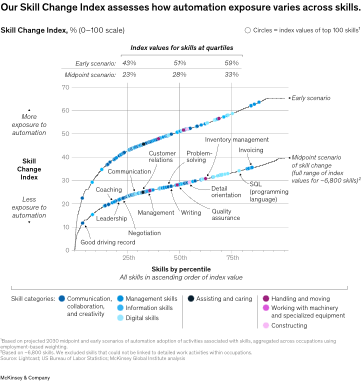
It is easy to say that AI will disrupt jobs, but any serious tax proposal depends on the numbers. Goldman Sachs estimates that generative AI could affect up to 300 million full time jobs globally and directly displace roughly 6–7% of the U.S. workforce, about 11 million workers, with 1 to 4 million jobs eliminated annually in the near term (Goldman Sachs). McKinsey projects that while a new $2.9 trillion dollars could enter the economy from AI growth, up to 60 percent of jobs could be affected (McKinsey). Check out this graph on how those jobs will be up-skilled and re-skilled as well.
Other institutions focus on jobs affected, but again, affected is not the same as replaced. The World Economic Forum’s Future of Jobs report estimates tens of millions of jobs impacted by AI by 2030 while simultaneously projecting new roles, and the IMF warns that 40% of jobs globally, and 60% in advanced economies, will be exposed to AI (WEF; IMF). To quantify the fiscal cost, we have to track jobs gone. A U.S. Senate staff report led by Sen. Bernie Sanders, for example, warns that nearly 100 million U.S. jobs could be displaced within the next decade and explicitly raises concerns about lost payroll tax revenue (U.S. Senate Report). In New York City, a worst case AI scenario projects 259,000 private-sector jobs lost and billions in tax revenue below baseline by 2030 (NYC Comptroller).
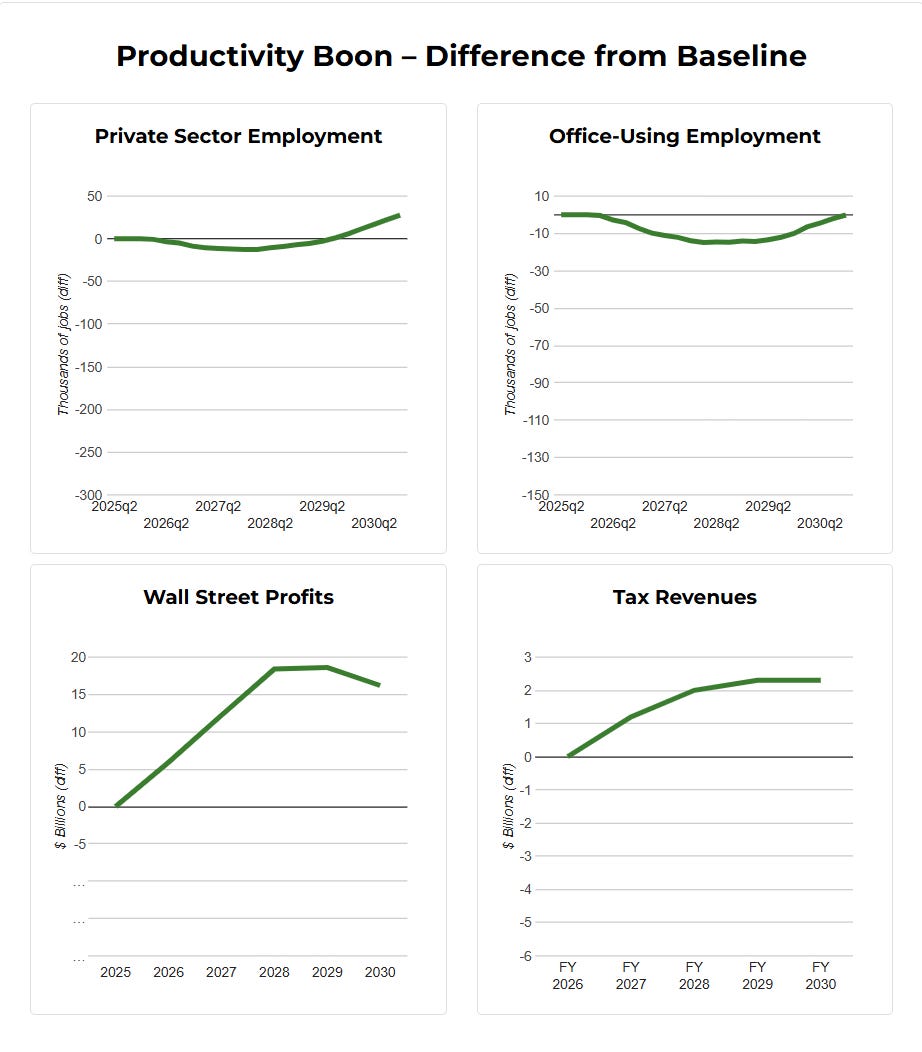
Payroll and income taxes together account for roughly 80–85% of federal revenue. Between about two thirds and four fifths of federal tax collections are tied directly to wages and salaries (Forbes) . When workers are displaced, their income and payroll contributions vanish. Some estimates suggest each displaced worker removes on the order of tens of thousands of dollars from federal revenue once you combine lost income tax and payroll contributions. As AI substitutes for labor, the effective tax rate on the capital replacing that labor has fallen sharply over the last two decades, meaning the government collects less per dollar of economic output even as the economy grows.
This dynamic hits young people especially hard. Recent graduates whose target jobs simply never exist because AI does them from day one are displaced without ever having been employed. They do not qualify for traditional unemployment benefits but face the same structural exclusion from the labor market.
My Proposition
A token is the fundamental unit of AI inference. Every API call, automated workflow, AI generated email, and agentic task is measured and billed in tokens by OpenAI, Anthropic, Perplexity, Google, and others. At its core, the amount of work AI does is measured in tokens. As of late 2025, the LLM API market was processing around 1.5 quadrillion tokens per month, roughly 50 trillion tokens per day. Thousands of organizations have already crossed the 10 billion token mark; some have exceeded 1 trillion tokens, and enterprise token consumption has grown by orders of magnitude year over year. (OpenAI; Fireworks AI)
A recent paper from Oxford University argues that token taxes are one of the most promising first line fiscal tools for an AI heavy economy. (Oxford / arXiv) Mark Cuban has floated a similar idea: charge less than 50 cents per million tokens for commercial AI providers and raise billions per year, scaling as usage rises. (Mark Cuban) The logic is simple. Instead of taxing AI enhanced capital gains in general, tax the most measurable unit of AI work that is already tracked in every enterprise billing system.
Crucially, this tax should apply to corporate AI usage, not to individual consumers using ChatGPT to write their English essays. Enterprise APIs and large scale deployments are already separated from consumer traffic in provider billing systems. The tax falls on firms that run trillions of tokens to replace labor, not on students using AI as a study aid.
In fact, maybe we need to rethink corporate taxes entirely. Take this example: a new company emerges that employs no workers (or very little) and uses AI to do most of its work. If it is true that this company is able to operate more efficiently in terms of both deadlines and cost management, the possibility that it starts to take over market share becomes very real. Logically, this would trigger responses from this new company’s competitors who have been around much longer. These responses would look like mass layoffs. And while, the companies ordering the layoffs would have to pay their workers, there still is no recourse for the company that never employed humans in the first place.
Moreover, corporates that have a larger labor income as a percent of total revenue by definition contribute more to the tax coffer via both the labor income tax and personal consumption. These companies should pay a smaller tax on the amount of tokens they use to incentivize retaining employees. Conversely, companies that have a smaller labor income as a percent of total revenue should pay a higher tax on the tokens they use. This way innovation is not as stifled in the short-term but employment is incentivized.
Just as important as the tax itself is what happens to the money. Token tax revenue should go into a dedicated fund that entails the following:
Support workers who are truly displaced by automation, through extended unemployment and transition stipends.
Finance retraining and vocational programs for an AI centric world, from community colleges and trade schools to AI related oversight and safety roles.
Carve out support for new graduates whose jobs never materialize and who therefore do not qualify for unemployment, through targeted student loan relief, bridge stipends, or subsidized co op and work study placements in roles that remain human.
Co-op programs like Northeastern’s, where students spend extended terms in paid industry positions during their degrees, are one way to adapt. As AI automates more entry level tasks, experience while studying may become the only viable pathway into certain professions. A token funded carve out could help scale such programs beyond a handful of universities, making paid co-op a new standard.
Before I conclude this post, I have one more final food for thought for y’all. Maybe the income inequality that plagues millions of Americans stems in part from the separate tax regimes for corporates and individuals. Corporates are incentivized to maximize profits at the expense of labor — and AI accelerates that. A recognition of each corporate’s unique contribution to the economy driving its tax rate may create a more harmonious system. For example, Meta’s revenue per employee is $2.55 million based on a workforce of ~79,000 (Bullfincher) and Walmart’s is $339,600 based on a workforce of 2.1 million (Bullfincher). Should they be paying the same tax rate?
Objections?
Will it stifle innovation? Bill Gates, in arguing for a robot tax, acknowledged that taxation could slow automation, but suggested that slowing it to a manageable rate was precisely the point. A modest token tax on corporate usage does not make AI prohibitively expensive; it raises costs at the margin. It functions more like an excise tax on a specialized input, analogous to long standing telecommunications surcharges.
Can companies relocate to avoid it? Because the tax is levied at the point of consumption, not where the model is hosted, routing computation through another jurisdiction does not avoid the levy on domestic usage. If the U.S. acts alongside the EU, UK, and Japan, regulatory arbitrage becomes significantly harder.
Will it be sufficient? No single policy will fully solve the fiscal and social disruption from AI displacement. For example, once / if enough labor is up-skilled and re-skilled, we won’t need a token tax. But a token tax is one of the few instruments that is measurable, enforceable using existing infrastructure, tied to actual AI usage rather than general capital returns, and capable of scaling automatically as AI adoption grows. Paired with a dedicated fund, it directly addresses both the lost tax revenue from displaced workers and the missing safety net for new graduates whose jobs never exist in the first place.
Thoughts?
If your main goal is to disincentivize displacing workers, it sounds like you might be reaching for something closer to a Pigouvian tax (https://arxiv.org/pdf/2603.20617). Or is this more of an excise task (purpose is mainly to generate revenue for the government)?